
Explore Słowosieć
Start with the guide
Relations between meanings
How to read a sense page
- 1 — sense header: lemma and the sense number within the synset.
- 2 — definition (gloss): a concise description of what the unit means.
- 3 — view buttons: links to the hypernym path, morphology, and synset graph.
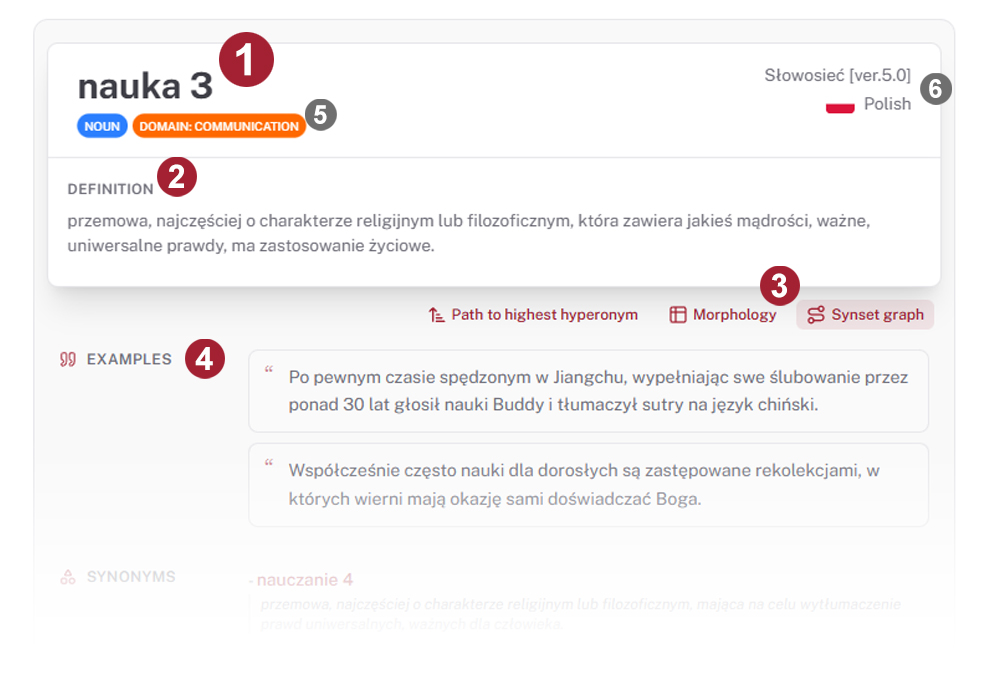
- 4 — usage examples: sentences illustrating the sense in natural context.
- 5 — domain: information about the semantic field (e.g., communication, medicine).
- 6 — resource info: the Słowosieć version and the language the sense comes from.
Lemma, sense, synset — what's the difference?
A sense page uses several linguistic concepts. It's worth organizing them to better understand their relations.
Lemma
The dictionary headword form under which you'll find all its grammatical forms and senses.
Example: pies as a lemma includes forms psa, psu, psami, and senses such as "domestic animal" or "a derogatory term for a person".
Sense
A specific way of understanding a lemma, described by a gloss.
Example: pies “domestic animal” vs. pies meaning “a derogatory term for a person”.
Synset
A synset (set of synonyms) in WordNet is the basic unit representing a single, specific concept or meaning. It groups synonyms that are interchangeable in a given context. Synsets are linked by semantic relations (e.g., hypernymy), forming a lexical network.
Example: the synset pies domowy “domestic dog” can include lemmas pies “dog”, and pies domowy “domestic dog”.
Variants and navigation across senses
Search results include variants and related concepts for a lemma.
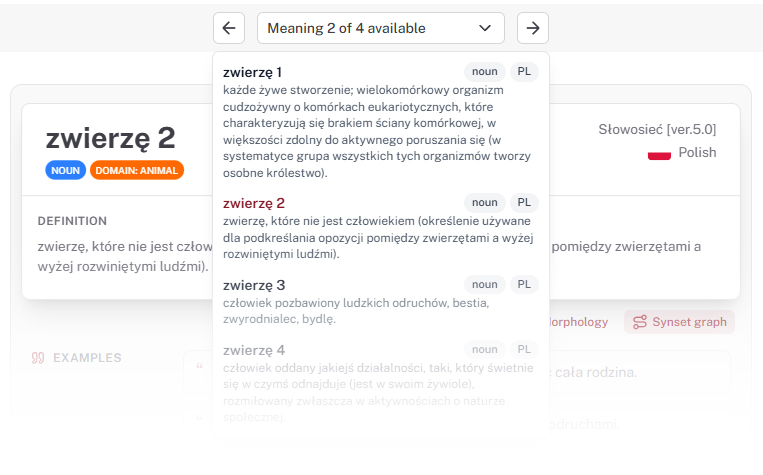
Sense variants
With sense variants you can see all meanings of a lemma in one place.
Sense navigation
Clicking a variant in the page header lets you move between senses of the same lemma. You can also use the arrows at the top of the page or keyboard shortcuts:
Shift + Arrow Left — go to the previous sense
Shift + Arrow Right — go to the next sense
Emotional annotations
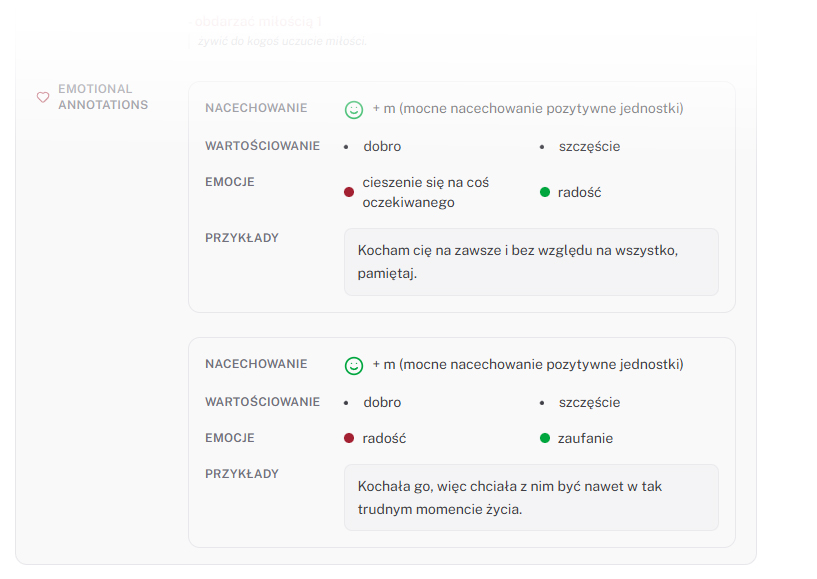
Sense connotation
The icon (sad, neutral, smiling) and shorthand like “+ m” summarize the overall emotional tone of a sense.
Layers of emotion description
Next to connotation you see valuation (good/bad), a list of emotions, and example sentences.
Working with emotions in research
Based on this, you can filter the resource for positive/negative senses or specific emotions.
Emoticons and connotation
In the Connotation column you see a combination of an emoticon and a shorthand (e.g., + m). This summarizes the overall emotional tone of a sense.
- Positive (+, + m): strong or mild positive connotation of a sense.
- Neutral (0): no clear connotation — descriptive meaning.
- Negative (-, - m): distinctly unpleasant or hurtful meanings.
Valuation, emotions, examples
- Valuation: a list of general assessments (e.g., good, happiness, harm) that show how a sense positions itself relative to good and evil.
- Emotions: specific emotion names (e.g., joy, trust, fear), each marked with a colored dot.
- Examples: sentences showing how such a sense and its emotions function in language — often short dialogues or narrative fragments.
Relations between meanings
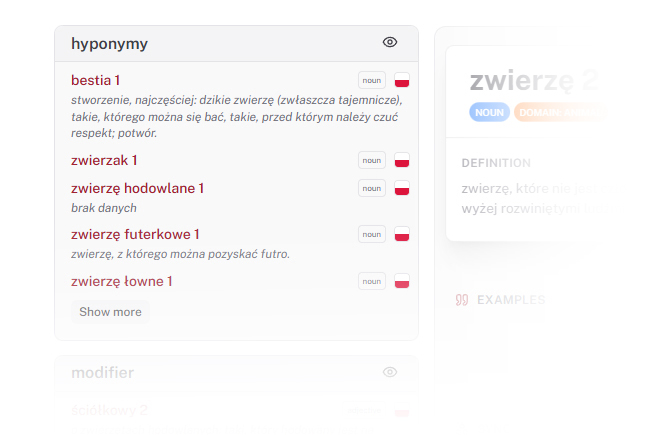
Relation columns
The columns on the left and right of a given sense contain relations between meanings.
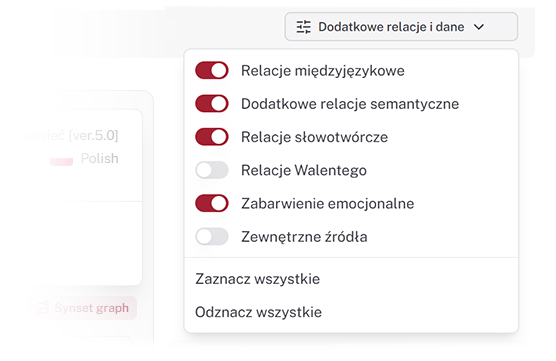
Additional relations and data
In the top right corner there is a control to show and hide additional relations and data contained in the sense.
Relation types
Słowosieć links meanings using many different relations.
From simple synonyms to complex relations known to linguists.
Synonyms
relationTwo meanings with very similar content, often forming the same synset.
”piękny” — ”szlachetny” meaning „positive in moral terms”.
See exampleHypernyms / hyponyms
relationA hypernym is more general, a hyponym more specific — like categories and subcategories.
“zwierzę” → “pies” → “owczarek niemiecki”.
See the diagramAntonyms
relationOpposite meanings that often appear in pairs.
“bohater” — “łajdak”, “radość” — “smutek”.
Other relations
relationE.g., part relations (meronymy), causal or associative — more specialized.
“ręka” as part of “ciało”, “burza” linked to “deszcz”.
Relation types
Each relation on the graph has an abbreviation. Click to see the full list of relation types in Słowosieć.
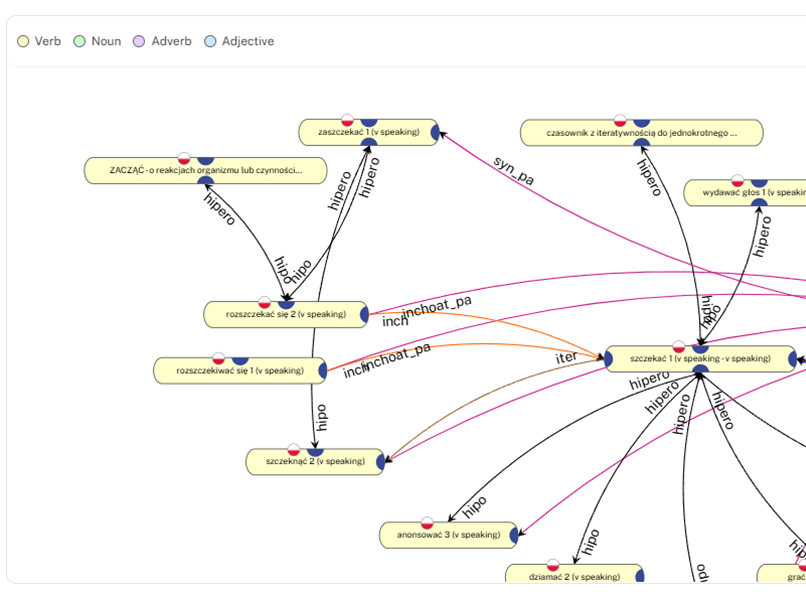
Relation graph
- Parts of speech colorsThe node color tells you whether you're seeing a noun, verb, adjective, or adverb.
- Relation arrowsArrow direction shows where the relation “flows” — for example from hyponym to hypernym.
- InteractivityGraph nodes can be expanded to grow the relation network.
Concept tree: hypernyms and hyponyms
- Moving upBy clicking a hypernym, you move to a more general concept (e.g., from “dog” to “animal”).
- Moving downBy clicking a hyponym, you move to more specific concepts (e.g., “German shepherd”).
- Concept pathA series of clicks forms a concept path you can use, for example, in semantic analysis.
Hypernym path for “owczarek niemiecki” “German shepherd”
- istota 1broadest hypernym
- owczarek niemiecki 1starting point
Derivational relations
What are derivational relations
Derivational relations describe how one word gives rise to others — e.g., a feminine form, diminutive, or deverbal noun. In Słowosieć you see them as links between senses.
Below are two families: a profession and its feminine form, and an aristocratic title with derived meanings.
- feminine forms (e.g., policjant → policjantka),
- semantic derivatives (e.g., książę → księżna, księżniczka).
Profession and feminine form
”a female person working as a police officer”.
Titles and derived meanings
“an aristocrat who is the wife of a prince”.
“daughter of a prince”.
See Słowosieć in action
Cross-lingual relations
Compare Polish senses with their English counterparts and see when a translation is full or only partial.
Register overview
See how Słowosieć marks archaic, group-specific, and other registers with examples.
Advanced use cases
See how researchers and developers use Słowosieć in real projects — from NLP to linguistic research.
Emotion hypernymy
Cross-lingual relations
Partial cross-lingual synonymy
The meanings are very close, but they can't be substituted 1:1 in every context.
Apprehension is a specific fear about the future, while Polish "niepokój" is broader, covering also a state of psychological unease.
Register differences
Cross-lingual synonymy across registers:
The Polish word is more official and archaic in tone than its neutral English counterpart.
Register overview: archaic, specialist, and more
How to read register labels
A register tells you in which situations a sense is typically used — whether the word is archaic, group-specific, official, or rather colloquial.
You'll find these abbreviations next to definitions — they let you quickly see a sense isn't general-use.
Register list in Słowosieć
- og.general
- daw.archaic
- książk.bookish
- nienorm.non-standard
- pot.colloquial
- reg.regional
- specj.specialist
- urz.official
- wulg.vulgar
- środ.group-specific (e.g. school, youth)
Colloquial sense
pot. pies 7
„człowiek, który za czymś przepada, łasy na coś...” — a sense used in colloquial language, deviating from the general-use meaning.
Archaic sense
daw. iluzjon 1
An older term for a movie theater — now a historical curiosity in texts about culture.
Specialist register
specj. łopatka 4
„część śmigła, śruby, element wykorzystywany do wprawiania w ruch jakiegoś mechanizmu.” — typical, for example, in technical contexts.
Former sense
daw. dziewczyna 3
Historical meaning „służąca, pomoc domowa” — today a common term for a young woman.
Słowosieć statistics
| Metric | Value | What does it mean? |
|---|---|---|
| Number of synsets | ≈ 231,000 | Approximate number of sense nodes in the entire network. |
| Number of lexical units | ≈ 297,000 | Number of lemma–sense pairs. |
| Number of synset relations | ≈ 611,000 | Connections between synsets (synonymy, hypernymy, etc.). |
| Number of lexical unit relations | ≈ 279,000 | Relations between lexical units. |
| Słowosieć | enWordNet | Princeton WordNet | |
|---|---|---|---|
| Verb | 21,139 | 1 | 11,542 |
| Noun | 137,362 | 11,173 | 119,201 |
| Adverb | 8,155 | — | 4,475 |
| Adjective | 29,692 | 1 | 21,866 |
| Total | 196,348 | 11,175 | 157,084 |
Source: Słowosieć statistics (June 2024)
